FRCR Part 1 Physics: Complete Exam Preparation Guide 2026 | Pass First Time
Master FRCR Part 1 Physics with proven strategies. Complete 2026 exam guide covering all 8 categories, question banks, timelines & NHS-specific tips.
On this page
FRCR Part 1 Physics: Complete Exam Preparation Guide 2026 | Pass First Time
The FRCR Part 1 Physics examination represents the most challenging component of UK radiology training, with historical pass rates of just 52-56%—the lowest of all Part 1 modules. This comprehensive guide provides proven radiology physics exam strategies specifically designed for busy ST1 trainees in NHS district general hospitals preparing for April or September 2026 sittings.
Picture this: three weeks before your FRCR Part 1, you're staring at 50 pages of physics notes on X-ray production and attenuation coefficients, wondering how you'll ever make sense of it all during your busy ST1 rotation in a hectic NHS district general. Sound familiar? Many trainees face this exact panic—juggling night shifts and cramming radiation physics while the RCR physics curriculum 2026 guidelines loom large. But with the right approach, you can pass on your first go.
Medical imaging physics often trips up even the sharpest trainees because it's not just rote learning—it's about applying concepts like beam hardening or Monte Carlo simulations to clinical scenarios, from CT dose optimisation to MRI gradients. With targeted ST1 radiology revision strategies, you can push your performance to 75%+ and pass first time. We've distilled what works: a structured timeline that fits around your on-calls, essential resources like the RCR's core physics module, and exam techniques to tackle those tricky multi-part medical physics true/false questions efficiently.
Key Takeaways
- Memorize 8 Categories: Matter/Radiation (3Q), Radiography/Fluoroscopy (6Q), CT (6Q), MRI (6Q), Ultrasound (6Q), Nuclear Medicine (6Q), Safety (6Q), Image Quality (6Q).
- Practice Time Allocation: 36 seconds per true/false statement; simulate 3-minute stems × 40 for 200 total statements.
- Recall Pass Benchmarks: Physics 52-56% historical rate; aim 75%+ using modified Angoff setting.
- Calculate 4-6 Month Timeline: 2 months core textbooks, then 4 months intensive true/false practice (2750+ questions).
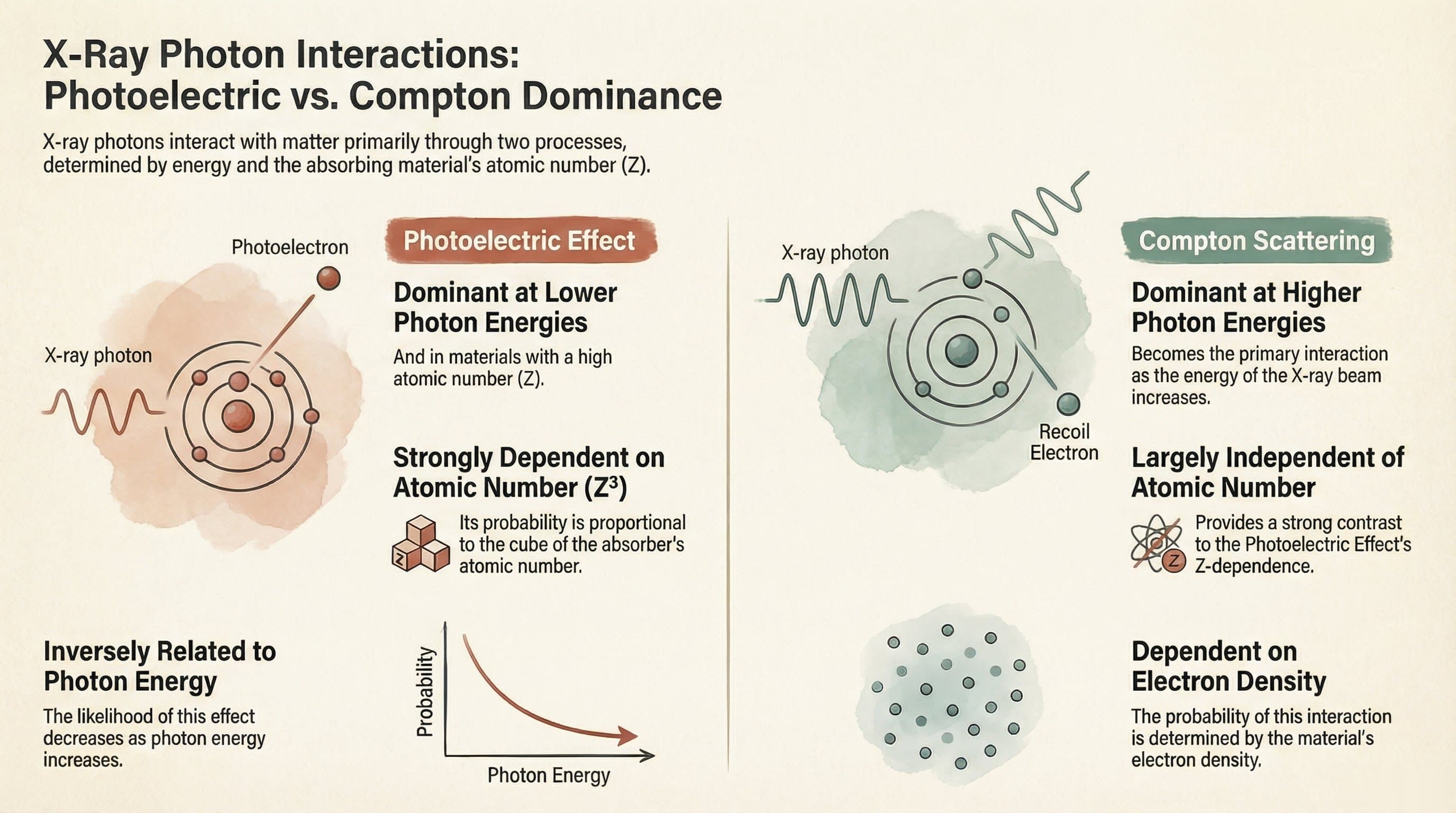
- Mnemonic for Interactions: "Photoelectric Peaks Low Energy" (under 30 keV, Z³ dependence); Compton dominant above.
- Draw Kerma Chain: Sketch air kerma → absorbed dose → equivalent dose (×w_R) → effective dose.
- Memorize Hounsfield Scale: Water 0 HU, air -1000 HU, bone +300-2000 HU for density recognition.
- Practice Attenuation Formula: I = I₀e^(-μx); calculate for 3 MHz ultrasound (0.5 dB/cm/MHz depth limits).
Frequently Asked Questions
What is the FRCR Part 1 Physics pass rate?
Historical FRCR Part 1 physics pass rates hover at 52-56%, the lowest of all Part 1 modules. The radiology physics exam UK presents significant challenges primarily due to dense topics like MRI gradient encoding and CT reconstruction algorithms. With targeted preparation using proven strategies, you can achieve 75%+ and pass first time.
How long should I study for FRCR Part 1 Physics?
A structured 4-6 month timeline works best for UK radiology training exam preparation: 2 months on core textbooks (Farr's Physics for Medical Imaging 3rd Edition, Allisy-Roberts' Physics for Diagnostic Radiology), then 4 months intensive practice with 2750+ FRCR physics true/false questions covering all 8 RCR categories.
What are the best FRCR Part 1 Physics resources?
Core textbooks: Farr's Physics for Medical Imaging (3rd Edition, 2022)—the gold standard FRCR Part 1 physics textbook aligned with RCR curriculum—and Penelope Allisy-Roberts' Physics for Diagnostic Radiology. For practice: RCR e-Learning modules (free for members) and create custom true/false questions from Farr's Physics end-of-chapter problems.
What topics are most important for FRCR Physics?
CT physics (6 questions), MRI sequences (6 questions), radiation safety/IRMR 2017 (6 questions), and radiography/fluoroscopy (6 questions) comprise 60% of the exam. High-yield topics include CT dose calculation FRCR (CTDI, DLP), radiation protection IRMR 2017 (Ionising Radiation Medical Exposure Regulations), and MRI physics simplified concepts like k-space and gradient encoding.
How is FRCR Part 1 Physics scored?
40 stems with 5 true/false statements each (200 total). Pass mark set via modified Angoff standard setting, typically 60-70% but aim for 75%+ safety margin. No negative marking—educated guesses on uncertain items beat leaving blanks.
How do I prepare for FRCR physics in 3 months?
Accelerated timeline: Month 1—speed-read Farr's Physics (50 pages/week) focusing on formulas and key concepts. Month 2—practice 1000+ true/false questions, review errors daily. Month 3—full timed mocks weekly, intensive revision of weak areas. Prioritize high-yield topics: Safety (IRMR 2017), CT dose metrics, MRI basics.
What's the difference between CTDI and DLP?
CTDI (Computed Tomography Dose Index, measured in mGy) represents scanner output measured in a standard phantom. CTDIvol adjusts for pitch (CTDI/pitch). DLP (Dose-Length Product, mGy·cm) represents total exposure: CTDIvol × scan length. Example: If CTDIvol = 10 mGy, scan length = 30 cm, then DLP = 300 mGy·cm.
Why do radiology trainees fail FRCR physics?
Common failure reasons: (1) Insufficient practice with true/false format—need 2000+ questions minimum. (2) Weak foundation in radiation protection legislation (IRMR 2017, IRR17). (3) Poor time management—36 seconds per statement requires discipline. (4) Gaps in modality-specific physics, especially MRI k-space and nuclear medicine dosimetry calculations.
FRCR Part 1 Physics vs Anatomy: Key Differences
| Aspect | Physics Module | Anatomy Module |
|---|---|---|
| Pass Rate | 52-56% (lowest of Part 1 modules) | Higher pass rate (varies by sitting) |
| Question Format | True/False (40 stems, 200 statements) | Multiple question types |
| Core Topics | 8 physics categories | Anatomical regions & systems |
| Study Duration | 4-6 months recommended | Varies by candidate background |
| Focus Area | Equipment operation & radiation safety | Cross-sectional anatomy & imaging |
| Key Resources | Farr's Physics, RCR e-Learning modules | Anatomy atlases, imaging references |
| Common Challenges | MRI k-space, nuclear medicine calculations | Spatial relationships, anatomical variants |
FRCR Physics Topic Difficulty Guide
High-Yield, Lower Difficulty (Master First)
- Radiation safety & IRMR 2017 legislation: UK radiation protection laws, dose limits, justification principles
- Basic X-ray production & interactions: Photoelectric vs Compton, Z-dependence, beam hardening
- Hounsfield units & CT density: Water 0 HU, air -1000 HU, bone +300-2000 HU
- Ultrasound frequency vs depth relationship: 0.5 dB/cm/MHz attenuation rule
High-Yield, Higher Difficulty (Focus Intensive Study)
- MRI gradient encoding & k-space: Phase vs frequency encoding, k-space filling strategies
- CT reconstruction algorithms: Filtered back projection (FBP) vs iterative reconstruction
- Nuclear medicine dosimetry calculations: Activity decay, effective dose, MIRD schema
- Advanced radiation protection calculations: Shielding requirements, scatter fractions, barrier design
Medium-Yield Topics (Don't Neglect)
- Fluoroscopy dose optimization: Pulsed mode, collimation, distance principles
- Ultrasound artifacts & Doppler physics: Aliasing, acoustic shadowing, Doppler shift equation
- Image quality metrics: MTF (Modulation Transfer Function), DQE (Detective Quantum Efficiency), SNR
FRCR Physics Formula Cheat Sheet
Print & Memorize These Core Equations for FRCR Physics Revision:
X-ray & CT
- Attenuation: I = I₀e^(-μx)
- Hounsfield Unit: HU = 1000 × (μ_tissue - μ_water) / μ_water
- CTDIvol: CTDI / pitch
- DLP: CTDIvol × scan length (cm)
- Effective Dose (CT): DLP × k-factor (mSv/mGy·cm)
MRI
- Larmor Frequency: ω = γB₀ (where γ = 42.58 MHz/T for protons)
- T1 relaxation: Mz = M₀(1 - e^(-t/T1))
- T2 relaxation: Mxy = M₀e^(-t/T2)
- Signal-to-Noise Ratio: SNR ∝ voxel volume × √(NEX) / √(bandwidth)
Ultrasound
- Acoustic Impedance: Z = ρc (density × sound speed)
- Reflection Coefficient: R = (Z₂ - Z₁)² / (Z₂ + Z₁)²
- Attenuation: 0.5 dB/cm/MHz (soft tissue rule of thumb)
- Doppler Shift: Δf = 2f₀v cosθ / c
- Axial Resolution: λ/2 (wavelength/2)
Dosimetry
- Equivalent Dose: H = D × wR (Sv) — radiation weighting factor
- Effective Dose: E = Σ(HT × wT) — tissue weighting factors
- Half-Value Layer: I = I₀ × (0.5)^(x/HVL)
- Inverse Square Law: I₁/I₂ = (d₂/d₁)²
Nuclear Medicine
- Activity Decay: A = A₀e^(-λt)
- Half-life: t₁/₂ = 0.693/λ (decay constant)
- Effective Half-life: 1/Teff = 1/Tphys + 1/Tbiol
Exam Format
Overview of FRCR Part 1 Physics Structure
The FRCR Part 1 Physics module forms a key part of your progression towards becoming a UK radiology registrar. You face 40 stems, each with five true/false statements, making 200 individual statements in total. This setup tests your grasp of radiological physics concepts, delivered via the Speedwell examination platform used by the Royal College of Radiologists (RCR). Each statement stands alone—you judge it independently as true or false, with no negative marking for wrong answers.
Expect questions in pure true/false format, where you decide on each statement based on your physics knowledge. This structure demands precision, as a single misjudgement affects your score directly. For your diagnostic radiology physics guide preparation, start by familiarising yourself with the RCR curriculum, which emphasises foundational knowledge in diagnostic imaging modalities applied to real NHS scenarios.
In practice, you'll encounter stems that link concepts across topics, such as X-ray production tied to safety limits or CT dose calculation metrics applied to pediatric protocols. This mirrors real clinical scenarios where you apply physics daily in imaging departments. Aim to strengthen confidence through targeted revision to navigate the exam's demands effectively and pass first time.
Topic Distribution Across 8 Core Categories
The exam balances coverage across eight distinct areas with precise weighting. You'll face six questions each for Radiography/Fluoroscopy, Computed Tomography (CT), Magnetic Resonance Imaging (MRI), Ultrasound, Nuclear Medicine/Radionuclide Imaging, Radiation Safety, and Image Quality, plus three questions for Matter and Radiation fundamentals (totaling 45 questions, though RCR formats 40 stems by combining some areas). This distribution ensures comprehensive coverage of medical imaging physics essentials without overemphasising one modality.
Historical data shows physics pass rates at 52-56%, the lowest of all Part 1 modules, so prioritise these weightings in your revision plan. For instance, in recent sittings, around 15% of stems focused on CT dose metrics (CTDI, DLP), reflecting their clinical relevance in NHS protocols. The even split across six-question topics means you can't afford gaps—weak performance in MRI or ultrasound directly impacts your overall score.
Understanding this weighting boosts your chances of passing first time. Track your progress against it using a spreadsheet or revision app to avoid gaps in areas like nuclear medicine imaging or radiation protection. With modified Angoff standard setting, consistent coverage here sets you up for success. Allocate study time proportionally: spend 40% on the big three (CT, MRI, Radiography), 30% on Ultrasound and Nuclear Medicine, 20% on Safety, and 10% on Matter/Radiation and Image Quality fundamentals.
Timing and True/False Question Strategy
You have two hours for the physics paper, giving about 36 seconds per true/false statement—think three minutes per stem with its five items. Practice under these constraints to develop speed and accuracy without rushing into errors. The true/false format rewards clear thinking, as each statement stands alone: "Compton scattering increases with higher atomic number—true or false?" (False: it's relatively Z-independent, unlike photoelectric effect.)
Question types often blend theory with application. In a past exam vignette, a stem described a fluoroscopy setup and asked if collimation reduces scatter—true, as it limits the primary beam area. Another tested whether increasing kVp from 80 to 120 reduces patient dose—true, via beam hardening. Simulate this in your sessions to handle the 40-stem structure smoothly without panic at the two-hour mark.
For your FRCR physics revision, incorporate timed drills early in your preparation phase. Start with 10-stem sets in 30 minutes, then build to full 40-stem mocks. This approach, drawn from RCR guidance and successful trainee feedback, helps you manage the 200 individual statements efficiently. Focus on decision-making speed: read stem carefully, evaluate each statement in 30-40 seconds, flag uncertain ones, and return at the end if time permits. No negative marking means educated guesses on flagged items beat leaving blanks.
Scoring and Pass Benchmarks
Pass marks vary by sitting, set via modified Angoff standard setting and sometimes Hofstee compromise, typically requiring 60-70% correct—aim higher at 75% for safety margin. Historical physics rates hover at 52-56%, meaning roughly half of candidates fail each sitting. Exceeding this benchmark requires strategic focus on high-yield areas like radiation protection IRMR 2017 (Ionising Radiation Medical Exposure Regulations) and CT dose calculations, which appear consistently.
Candidate attempt limitations allow three tries overall for Part 1 across all modules, so get it right early to avoid pressure on later attempts. In recent sittings, many succeeded by nailing safety questions (six per exam), which make up about 15% of the paper. Use physics true/false practice banks to benchmark against these standards—if you're scoring 70% in mocks six weeks out, you're on track; below 65% means intensifying weak topics.
Track your mock scores against RCR's modified Angoff benchmarks weekly. This keeps you motivated and aligned with UK radiology registrar exam standards. Success here paves the way for Parts 2A (clinical SBAs) and 2B (rapid reporting, long cases, vivas). Remember: Part 1 Physics is pure true/false knowledge testing, unlike the clinical reasoning in later parts. Master the facts, apply them to vignettes, and you'll pass first time.
Study Strategies
Preparation Timeline and Phased Approach
For your FRCR physics exam preparation, commit to 4-6 months of structured work. In months 1-2, establish fundamentals with core texts like Farr's Physics for Medical Imaging (3rd Edition, 2022)—the gold standard FRCR Part 1 physics textbook aligned with RCR curriculum 2026—and Penelope Allisy-Roberts' Physics for Diagnostic Radiology; then shift to 3-4 months of intensive FRCR physics true/false practice questions using RCR e-Learning modules and Farr's end-of-chapter problems (2750+ questions total). Create a checklist covering all eight RCR categories (Matter/Radiation, Radiography, CT, MRI, Ultrasound, Nuclear Medicine, Safety, Image Quality) to monitor your coverage systematically.
- Week 1-4: Master basic radiological physics concepts, reading 20-30 pages daily on X-ray production and interactions.
- Month 2-3: Introduce modality-specific physics through diagrams and formulas—sketch MRI relaxation curves, CT dose chains.
- Month 4-6: Ramp up timed mocks, reviewing errors weekly to identify patterns (e.g., consistent mistakes on ultrasound attenuation).
This phased approach, recommended in RCR resources and by successful trainees, prevents burnout while ensuring comprehensive coverage. Adjust based on your NHS rota—perhaps study evenings post-clinic or weekends for deeper dives. It ensures you pass first time by building solid foundations before intensive question practice.
Essential FRCR Physics Resources 2026
Primary Textbooks (RCR-Aligned)
-
Farr's Physics for Medical Imaging (Penelope Allisy-Roberts & Jerry Williams, 3rd Edition 2022)
- Gold standard for FRCR Part 1 physics
- Complete coverage of all 8 RCR categories
- End-of-chapter problems simulate true/false format
- £45-55 on Amazon
-
Physics for Diagnostic Radiology (Allisy-Roberts & Williams)
- Deep dive into radiation interactions & dosimetry
- Excellent for Matter/Radiation fundamentals
- Complements Farr's for difficult topics
Quick Reference Guides
- Farr's FRCR Part 1 Revision Notes (condensed version for rapid review)
- RadSTAR Physics Tutorials (RCR platform, free for RCR members)
- RCR Physics e-Learning Modules: Interactive modules covering Safety, CT, MRI with integrated quizzes
Free Practice Resources
- RCR e-Learning modules: Interactive radiology physics formulas and physics modules covering Safety, CT, MRI
- Farr's textbook questions: 50+ true/false style problems per chapter covering FRCR physics revision notes topics
- Create custom questions: Convert Farr's end-of-chapter problems into true/false format for self-testing
How to Master CT Dose Metrics for FRCR Part 1
Step 1: Memorize the Dose Chain
CTDI → CTDIvol → DLP → Effective Dose
- CTDI (mGy): Scanner output, measured in standard phantom (16 cm head, 32 cm body)
- CTDIvol: Adjusted for pitch (CTDI/pitch) — accounts for table movement
- DLP (mGy·cm): Total exposure (CTDIvol × scan length)
- Effective Dose (mSv): Organ-weighted risk estimate (DLP × k-factor)
Step 2: Practice Calculations
If CTDIvol = 10 mGy, scan length = 30 cm:
DLP = 10 × 30 = 300 mGy·cm
If DLP = 300 mGy·cm, k-factor (chest) = 0.014 mSv/mGy·cm:
Effective Dose = 300 × 0.014 = 4.2 mSv
Step 3: Link to Clinical Scenarios
Pediatric protocols: Lower kVp (80 vs 120) exploits photoelectric dominance in small bodies, cutting dose by 40%+. For IRMR 2017 compliance, always justify CT exams and optimize protocols using diagnostic reference levels (DRLs).
Common Mistakes and How to Avoid Them
Mistake 1: Confusing Radiation Weighting Factors
Error: Mixing up wR (radiation weighting) and wT (tissue weighting).
Solution: Remember: wR modifies absorbed dose → equivalent dose (radiation type matters). wT modifies equivalent dose → effective dose (organ sensitivity matters).
Mistake 2: MRI Safety Misconceptions
Error: Thinking all metallic implants are MRI contraindications.
Solution: Learn specific contraindications: cardiac pacemakers (unless MR-conditional), cochlear implants, ferromagnetic aneurysm clips. Titanium joint replacements are generally safe.
Mistake 3: Poor Time Management
Error: Spending >1 minute per statement, leaving 20+ unanswered.
Solution: Strict 36-second rule. Flag uncertain items, return at end. Practice with timer in every mock session.
Conclusion
Mastering FRCR Part 1 Physics requires a structured approach: 4-6 months timeline, RCR-aligned resources like Farr's Physics for Medical Imaging, and intensive practice with 2750+ true/false questions. Focus on high-yield topics—CT dose calculation, radiation protection IRMR 2017, MRI physics, and safety regulations—which comprise 60% of the exam.
With historical pass rates at just 52-56%, strategic preparation makes the difference. Use the formula cheat sheet, practice timed mocks weekly, and track progress against RCR's modified Angoff benchmarks. Aim for 75%+ in practice to ensure first-time success.
Start your focused prep today with our diagnostic radiology physics guide strategies and join the ranks of successful UK radiology registrars. The RCR physics curriculum 2026 is challenging but conquerable with the right plan.